
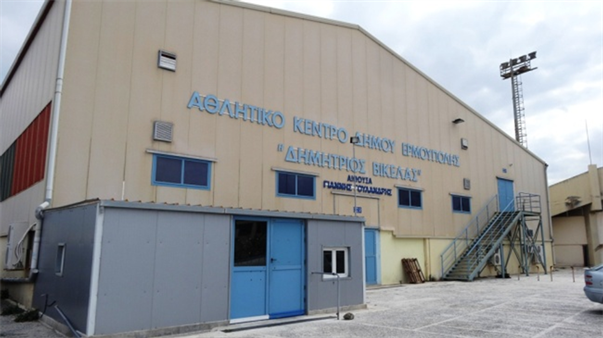
The “Dimitrios Vikelas” athletic center in Ermoupolis of Syros, Steel Structure Greece, consists of two buildings. Building B has a Steel Structure superstructure that was constructed approximately 35 years ago. It was initially used as a boat shelter and no design calculations were made. It contains steel columns with varying cross section heights. The spans are bridged via trusses and I-beams. Significant geometrical inconsistencies are noted among the existing steel connections and failures have been recorded as a result of buckling in several beams and bracings during the service life of the athletic center. The current study presents an investigation performed in order to diagnose building structural problems and propose strengthening and intervention measures. The goal of this study was to improve the load-carrying capacity of the structure in order to comply with the current design codes. Moreover, enhancement of the dynamic properties of the strengthened structure was demonstrated using modal analyses. The structural behavior was determined in a more precise manner via non-linear wind time-history and incremental static analyses. The analytical results explain the development of failures in the existing structure.
The importance of accurate and timely structural estimation is widely accepted by the civil engineering community. Safety concerns make achieving this challenging when dealing with damaged structures of high importance that are currently in use. Two of the main goals of structural assessment of an existing structure are to predict adequate structural behavior (and therefore a satisfying reliability throughout its service life) and to optimize cost [1] .
Prior to the proposal of strengthening measures, the design Engineer should have cautiously investigated the influence of various inaccuracies of the structure on the total response. Learning from structural failures study offers a great insight on structural problems, combining both the theoretical and the construction point of view. Several examples of steel structural failures arising from wind load are referenced by Iwicki [2] , for instance out-of-plane buckling of roof trusses under upward wind loads. Generally, light steel structures (like roof trusses from angle sections) are more susceptible to wind loads compared to heavy weighted structures [3] .
To the best of the authors’ knowledge, most researchers thus far have addressed wind engineering theoretically [4] – [11] without coupling their analyses with case-study failure investigations. Some studies have used database-assisted or testing-assisted design methodologies [4] [5] [6] [7] , while wind loading simulations performed via probabilistic processes [8] [9] [10] , or reliability-based design approaches [10] [11] have drawn significant interest over the past few decades.
The field of forensic structural engineering has recently become attractive for many engineers. R.T. Ratay published an interesting overview [12] , in which the main aspects, difficulties, and future dynamics of the field were presented. For instance, structural failure is typically defined as non-conformance with design expectations that provide minimum performance requirements. However, it can also consist of a high risk of potential failure. There are typically no signs of deterioration in the latter case. Conclusions can be determined via structural analyses or/and field investigation and testing. Finally, the author highlights individual skills and judgement and even the temperament of the specialist-engineer, as being of major importance. On the other hand, in recent years risk assessment gain more attention when it comes to insurance matters. A study that discusses the property losses of buildings after strong wind events is demonstrated in [13] .
The present work addresses a case-study of a steel structure with damage significant enough to threaten its safety. Strengthening measures are thought to be necessary in order to protect human life. The paper also focuses on the precise response of the structure under realistic simulations of environmental actions, specifically wind.
Building B of the “Dimitrios Vikelas” athletic center (Figure 1) is located in Ermoupolis in Syros, Greece. It was constructed in the 1970s and is located 30 m from the open sea, where it was initially used as a boat shelter. Today, it is used as an indoor volleyball facility. Since various structural damage has been observed, Maraveas C. & Associates P.C. was hired to perform a structural assessment of the building and propose strengthening measures.
The overall plan area of the metal building is 1228 m2.