
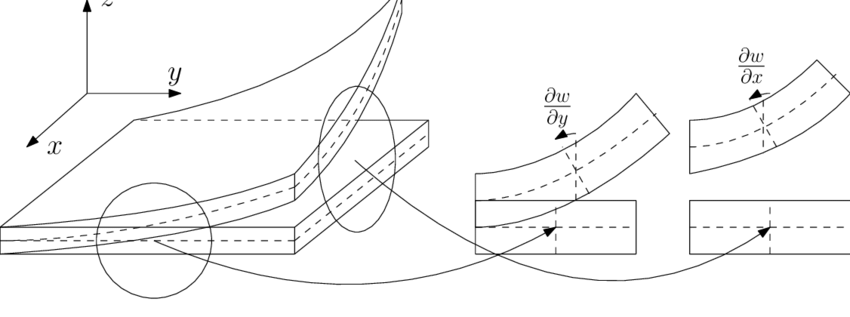
The pure shear strength for the all-simply supported plate has not yet been found; what is described as pure shear in that Kirchhoff’s Plate, is, in fact, a pure-shear solution for another plate clamped on the “Y-Y” and simply supported on the long side, X-X. A new solution for the simply supported Kirchhoff’s Plate case is presented here and is found to be only 60-percent of the currently believed results. Comparative results are presented for the all-clamped plate which exhibits great accuracy. The von Misses yield relation is adopted and through incremental deflection-rating the effective shear curvature is targeted in aspect-ratios. For a set of boundary conditions the Kirchhoff’s plate capacity is finite and invariant for bending, buckling in axial and pure-shear and in vibration.
Plate-bending is expertly covered by Timoshenko and Krieger [1], 1959, including the contributions of many other authors. Deflection-rating of plates will continue to rely heavily on these works. The treatise of Arthur W. Leissa [2], 1985, Ohio State University for Wright-Patterson Air Force Base-Flight Dynamics Laboratories gives a comprehensive discourse in buckling, encompassing shear-buckling and the Euler one-dimension case and citing the works and results of many others; no new pure shear solution was offered. Additionally an extensive review of shear buckling in isotropic plates by D.L. Johns [3] is available; the important correlation between the results and von Misses shear was not discussed. Mansour and Thayamballi for the Ship Structure Committee [4] in their 1980-document shed light on pure-shear plate-buckling in relation to the use of stiffeners, as in Figure 1. This present study is assuming that a stiffener-line and a simple-support line behind it amounts to zero-slope boundary, θxx-support=0θxx-support=0, in effect clamping. By the intervention of stiffeners the basic all-simply supported plate was interrupted.
Timoshenko’s results for Figure 1 case were quoted [4],
Nxy=Dπ2[5.35+4/(b/a)2]Nxy=Dπ2[5.35+4/(b/a)2]
this, as the all-simply-supported plate, appears to make no adjustment for the absence of the stiffeners. For a square plate “ Nxy=9.35Dπ2Nxy=9.35Dπ2 ”, this formula persists to date.
Piscopo [5] addressed the pure shear solution in the fashion of Timoshenko where the governing equation, “ D∇4w=(Nxy)(2∂2w/∂x∂y)D∇4w=(Nxy)(2∂2w/∂x∂y) ” is enhanced as Equation (1)
D∇4w=Nxy(β∂2w/∂x2+2∂2w/∂x∂y)D∇4w=Nxy(β∂2w/∂x2+2∂2w/∂x∂y)(1)
but a direct equilibrium solution for the latter has never been found. Incidentally, there appear to be some conflicts between Equation (1) and von Misses yield relation of Equation (2)
σ2vm=(1/2)[(σ1−σ2)2+(σ2−σ3)2+(σ3−σ1)2]σvm2=(1/2)[(σ1−σ2)2+(σ2−σ3)2+(σ3−σ1)2](2)
σvm=(σ21+σ22+σ1σ2)1/2σvm=(σ12+σ22+σ1σ2)1/2, in the “ σ1−σ2σ1−σ2 ” plane
A degenerate form of this equation for “ σcompression≫σtensionσcompression≫σtension ”, is
σvm=βσ1σvm=βσ1
or in terms of curvature,
Xvm=βX1Xvm=βX1(3)
Find “ X1=XeffectiveX1=Xeffective ” and the pure shear problem is solved in the “von Misses/Kirchhoff’s” framework. So Equation (1) is consumed by Equation (3), leading to,
D∇4w=(Nxy){β(∂2w/∂x2)effective}=(Nxy)(XVM)
Equation (4) is now the new standard pure-shear equation.
The present study starts with the buckling problem but assumes a great familiarity in the bending-deflection cases. Deflection factors are related to the desired curvatures. The deflection-factors employed emanate from the capacity of the Kirchhoff’s plate differentials which form the basis of all analyses, analytical or numerical finite-elements; these factors, when found, are easily recognizable, confirming that solutions are on track. Also, a fast approximate spot-buckling-solution is necessary for additional checks; Mohr’s loading curvature-circles (Figure 2) are devised to meet this.
The Kirchhoff’s plate capacity is constant whether in shear or axial compression, so there is no need to engage in a new extensive independent analysis in shear where von Misses shear solution can be invoked. The pure-shear plate buckling is hugely significant on account of the heavy demands on heavier and heavier ships and their platting.