
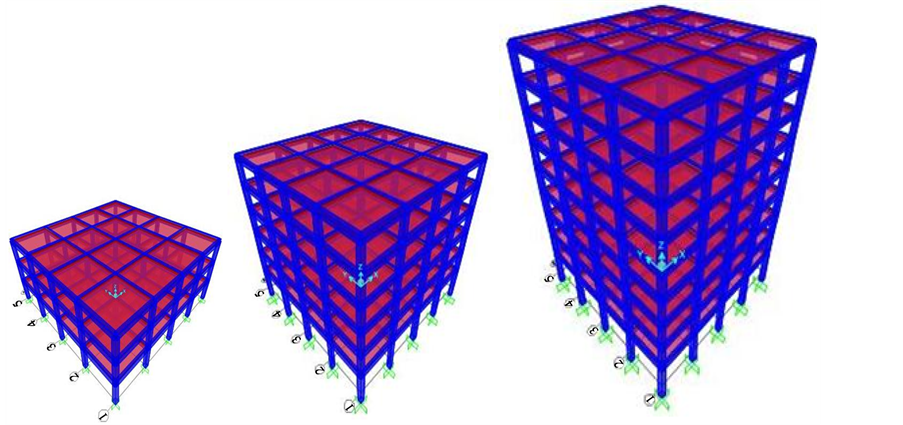
 The aim of this study is to assess the performance objectives defined in the Iraqi Seismic Code (ISC) in order to make a realistic evaluation related to Performance Evaluation Seismic Design (PBSD) of multi-story reinforced concrete buildings and also to compare and evaluate structural response demands obtained from nonlinear static analysis procedures according to two versions of the capacity spectrum method (CSM) which are recommended in ATC 40 and ATC 55. Two Performance Evaluation groups of three-dimensional RC buildings with different heights, designed according to Iraqi Building Code Requirements for Reinforced Concrete (IBC), are investigated. Pushover analyses are carried out to determine the nonlinear behavior of the buildings under three different seismic hazard levels, for two Iraqi seismic zones, of earthquake loads. In order to determine performance levels of the buildings, maximum inter-story drift demands and plasticizing sequence are determined and compared with the related limits using the CSM recommended in ATC 40 and ATC 55. From the results of this research, it can be concluded that RC buildings designed according to the Iraqi codes sufficiently provide the performance objectives stipulated in the ISC. Comparing structural response quantities obtained from the two versions of CSM, effects on performance evaluations of the buildings are investigated comparatively, as well.
Building damages and collapses in severe earthquakes have caused huge life and economic losses, in different parts of the world. Even smaller earthquakes have also caused the inelastic behavior in buildings. Therefore, it is necessary to examine and discuss the current country codes and develop alternative approaches to the traditional force based design [1] . Performance-based design (PBSD) is a major shift from traditional structural design concepts and represents the future of earthquake engineering. The procedure provides a method for determining acceptable levels of earthquake damage. Also, it is based on the recognition that yielding does not constitute failure and that preplanned yielding of certain members of a structure during an earthquake can actually help to save the rest of the structure. The structural engineer is interested in its concepts due to its potential benefits in assessment, design, and better understanding of structural behavior during ground motions. It also, permits the owners and designers to select personalized performance goals for the design of different structures. It seems that PBSD concepts, which allow multi-level design objectives, can provide a framework to improve the current codes; by obtaining structures that perform appropriately for all of seismic hazard levels [2] .
In determination of response demands for seismic assessments of buildings within PBSD concept, nonlinear static analysis procedures (NSPs) are becoming more popular in structural engineering practice. Although nonlinear time history analysis is the most reliable analysis in determination of the seismic response demands, it requires rather sophisticated input data and provides output, which is difficult to interpret. For this reason, NSPs are frequently used in ordinary engineering applications to avoid sophisticated assumptions required by the latter. As a result, simplified NSPs recommended in ATC 40 [3] , FEMA 237 [4] , FEMA 356 [5] , and other documents have become popular [6] [7] .
The nonlinear static procedure requires development of a pushover curve, a plot of base shear versus roof displacement, by nonlinear static analysis of the structure subjected first to gravity loads, followed by monotonically increasing lateral forces with a specified invariant height wise distribution. At least two force distributions must be considered [5] [7] .
Then, maximum structural response demands, (such as drifts, plastic rotations, inter-story drifts, shear strength, etc.) are obtained by using this curve. Single degree-of-freedom (SDOF) system approach is used in determination of demands in NSPs recommended in ATC 40 and FEMA 356, which is called as capacity spectrum method (CSM) and displacement coefficient method (DCM), respectively. However, these procedures have some discrepancy in determination of displacement demand for the same building model and under a specific ground motion [8] [9] . Consequently, same building performances may not be obtained due to these discrepancies in the analysis procedures.
Applied Technology Council with funding provided by FEMA conducts the ATC 55 [10] project to overcome the deficiencies and discrepancies in the NSPs using performance based engineering methods for seismic design, evaluation, and rehabilitation of buildings [11] . The ATC 55 Project has two objectives: the development of practical recommendations for improved prediction of inelastic structural response of buildings to earthquakes (i.e., guidance for improved application of inelastic analysis procedures), and the identification of important issues for future research.
The capacity spectrum method (CSM) has gained considerable popularity amongst pushover users since its introduction in 1975 by Freeman and collaborators [12] [13] . Chopra and Goel [14] found some flows in CSM version of ATC 40. The ATC 55 project derives the optimal vibration period and damping ratio parameters for the equivalent linear system by minimizing the differences between its response and that of the actual inelastic system and rectifies the flows in the original version [8] . For this reason, it is of prime importance to investigate effects of the CSM versions in performance evaluations of RC buildings, having different structural characteristics, within PBD and assessment concept.
In order to obtain useful elements of comparison between the two versions of CSM, the building performance is evaluated in this work with the features proposed in ATC 40 and ATC 55 and by comparing the seismic response estimation of the analyzed buildings in terms of drift profiles, roof drift ratios, inter-story drift ratios, base shear demands and plasticizing sequence due to component rotational demands.
Performances of RC buildings designed according to the Iraqi Building Code IBC 1987 [15] and Iraqi Seismic Code ISC 1997 [16] are examined, in an attempt to investigate the behavior of RC buildings in Iraq through evaluation of the performance objectives stipulated in the ISC. As in several contemporary country codes, general principles of earthquake resistant structure design are stated in the ISC 1997, which consists of rather indistinct definitions concerning the expected seismic hazard and damage levels. Stipulated performance objectives of the ISC are as follows:
1. The structure should withstand, without any structural and non-structural damage, the effects of slight seismic motion.
2. The structure should withstand, with limited non-structural damage and limited non-linear behavior of structural members, the effects of moderate seismic motion (design earthquake).
3. The structure should not collapse under sever or maximum expected earthquake.
The code provisions attempt to provide these performance objectives with various requirements (i.e., ductility and capacity requirements, displacement restrictions, etc.). These restrictions are very similar in all of the contemporary codes. However, it is not possible to check the states of the stipulated performance objectives by means of the traditional force based design. In order to determine the expected performances of the buildings, the performance based approaches including displacements rather than forces should be used in design and assessment.
Two groups of three-dimensional RC multi-story buildings are investigated in this study. Each group has three buildings (3, 6, and 9 stories). The buildings in the first group have a soft story, while those in the second group have none. In order to determine building performance, base shear?roof displacement relationships (capacity curves) of each building designed according to Iraqi codes are obtained by pushover analysis.
Each building is subjected to two kinds of lateral load distribution, P1, and P2, across its height. The first one is according to an equation of equivalent static forces as in ISC, while the second is proportional to the story masses at each story level. Two different seismic zones were chosen from the seismic zoning map of Iraq and three seismic hazard levels, derived from the ISC design spectrum, are considered in this study for each zone. Then, buildings’ performances are determined using the two versions of CSM. Comparing the performances of the modeled RC buildings to the stipulated objectives in the ISC, the behavior of RC buildings in Iraq is evaluated.